
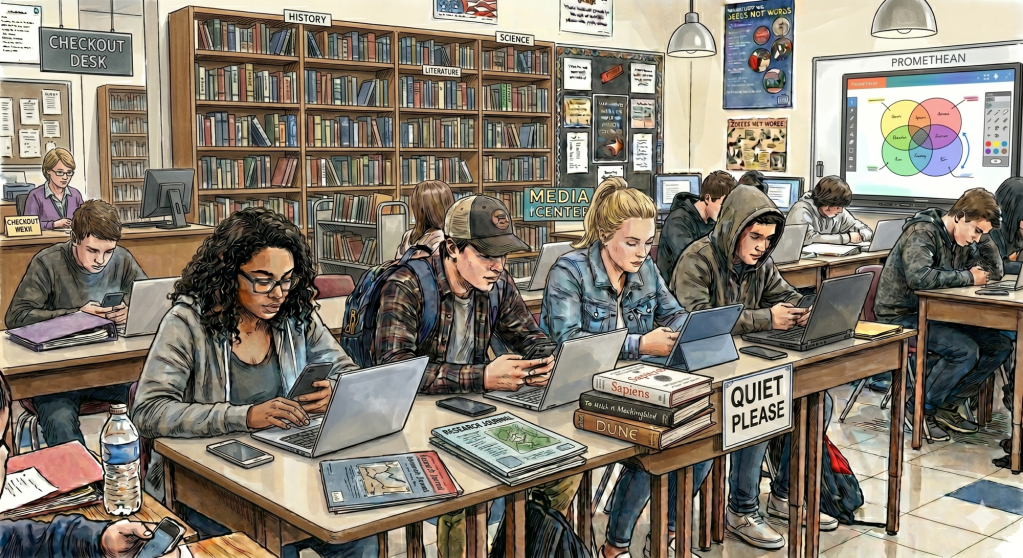
My 9th grade Lit Comp 1 class is currently creating annotated bibliographies centered around their chosen research question. The question pertains to the topic of juvenile justice (this was not my choice). So far, we’ve vetted several types of sources from different online articles to a podcast episode about a 19-year old’s experience in the juvenile justice system. The students have been exposed to several aspects of this topic, aware that the juvenile justice system can serve as either a place of punishment or a source of rehabilitation. Now that students are informed of these details, they can form their own opinion of the topic by addressing a concern they find intriguing.
The media center serves as a hub for several different purposes. Students can arrive here to find books catered to their literary preferences, access technology they may not possess daily, or complete assignments given to them by other teachers. Lately, students arrive here to skip class and ditch lunch due to the cafeteria’s variety of dislikeable options. I personally like to use the facility as an alternative learning environment. It lacks the sometimes-claustrophobic atmosphere of a classroom limited by four plain walls and a small number of windows.
Here at the media center, tables are spaced apart, leaving room for teachers to walk around and examine the progress of their students. Lately, I’ve given my students space to complete their assignments to increase independence. I teach 14- and 15-year-olds who are years away from becoming young adults. Some are driving and working part-time jobs, but eventually, they’ll be responsible for their entire lively hood. They may even be the sole breadwinner of their household. If they are going to take upon those responsibilities, they will need to grow in more areas than one. They require growth in both hard and soft skills where they’re able to effectively communicate ideas and analyze dense information. This can be done with consistency, hard work, and shared intentionality amongst a vast group of parents, teachers, and administrators. The problem is…the behavior of the students reflects a lack of structure and reliability…and it’s only getting worst.
One of my Lit Comp 1 classes houses Honors students, most of which transferred from a private school. One would assume that their character consists of dedication, mental fortitude, and vigor that promises classroom participation across all subjects. This is every teacher’s idea classroom (I assume). Most students in this class produce 95-100% attendance, rarely providing an empty desk on any given day. They are usually present and ready to learn but find themselves distracted by the thousand-dollar world gripped in the palm of their hands. Their electronic planets control the way they think, feel, and ultimately operate. Their phones are also the source of chronic dishonor and lack of academic integrity. It’s difficult for me to trust the ability of these students when Chat GPT and Microsoft Polit are writing their essays and completing their weekly assessments. They are creating their own glass ceilings that are hard to shatter when they’re not strong enough to surpass their current levels of cognitive thinking. If the Honors students are practicing such a disloyal act against school and institutional policies, imagine what the average student does when they constantly feel incompetent, inadequate, unworthy, and worse—unseen?
Two of my favorite comedians are Dave Chappelle and Ali Saddiq. Talking about master storytellers. Chappelle does a great job of incorporating history and modern politics into his material, making it relevant and quite humorous. Ali tends to take moments from his life and allows his audience to receive a first person-point-of-view of what it feels like to be Ali, but most importantly, how it feels to be a growing, learning human being.
Some of the topics mentioned in their acts, to the average person, can appear unrealistic and increasingly imaginative. Chappelle joked about the complexity of sexuality in the LGBTQ community in several Netflix specials while Ali compartmentalized his experiences as a drug dealer and prison inmate in 3 one-hour-long specials on YouTube. Many considerthese specials hilarious because both comedians find the “funny” in dysfunction. It’s because it’s true, one would say when laughing at Chappelle’s jokes about his late friend Daphne Dorman—a trans woman who was ridiculed online for defending Chappelle’s standup on a relevant, controversial topic. On the other hand, some may agree with the validity of that same phrase but possess a distasteful point of view. The truth hurts, specifically when you find what’s being said more harmful than hilarious.
I feel that modern education is a joke laughable to the students…but tragic to the teachers. We can’t find the “funny”in the dysfunction of both parents and adults reinforcing bad habits, causing students to reenact warranted behavior in the classroom. We can’t laugh when the punchline is students up inage having much lower reading levels according to state testing. We can’t repost laughable moments from the classroom when students use their phones to write their narratives opposed to using their imagination to retell life-changing opportunities that play into their own origin stories. We can’t find the play on words when students rather throw their fists than share their words when expressing their emotions. The students are chuckling when their peers are getting kicked out of class or hear their friends are failing several courses with averages far below 60. They laugh until it hurts. As a teacher, it hurts…until it burns.
As students learn new material, the ultimate outcome is to have them produce something that illustrates their mastery of the content. It’s all about application. It’s all about producing a solution to a problem, whether it’s Social Studies or Algebra. As class proceeds, I hear several conversations about everything that has nothing to do with the subject at hand. I hear the details of a teenager’s sex life that is more active than my own. I hear girls turning their tongues into knives, ending friendships by a thousand cuts. I see boys laughing at a picture in “the group chat” that probably includes an intrusive photo of a young girl a few desks away from them. I see a young girl taking advantage of the accommodations mandated on her 504 plan by never doing work but constantly asking for extensions on assignmentsafter spending 50-minute-long periods reenacting the latest TikTok trends. This…is not a joke. If anything, it’s a Shakespearean tragedy.
William Shakespeare’s work traditionally includes several common literary elements to illustrate a theme such as betrayal, hunger for power, or desire for love. Those elements include a tragic hero, the narrative structure, conflicts, supernatural elements, universal themes, and of course, comic relief.
The Shakespearian play that occurs chronically at our school labels the teacher as the protagonist. They are constantly fighting on behalf of the student who is challenged by multiple obstacles, human and materialistic. The teacher’s tragic flaw is their compassion, for they care too much to allow a student to succumb to those obstacles that can hinder their development. The supernatural force that exists appears to possess most of the student body where they are highly dependent and ill-motivated, transferring into the spirit of the educator, making them less inspired to teach and guide, let alone enter the building. There’s a tragic waste of energy, time, and knowledge that is daily dumped into the headphones and low-battery cellphones of most of the student body. Internal and external conflicts undergo a constant battle for the attention of every kid capable of learning and excelling but are distracted by expectations beyond their control. Teachers struggle as well, because they must answer the following question daily: Is what I’m doing making a difference?There is no poetic justice for those willing to go the extra mile while their peers struggle to cover an inch. Lastly, there is nocomic relief, for the metaphoric bloodshed smears a teacher’sgrade book with incomplete assignments and a disconnect between the learned material and the daily realities of their students.
Everyday is a comedy special. Students run up and down the halls during class time. Others take trips to the gas station opposed to showing up for a scheduled test. Opportunities to read and write are overridden by urges to eat spicy potato chips and watch teen and adult dramas on varied streaming platformsas teachers strive to assist them during guided learning sessions. If this was a movie, and I paid $15 to see it, I would still walk out within the first 5 minutes. This humor…is too dark for my soul.
Ephesians 6:12 reads, “For we wrestle not against flesh and blood, but against principalities, against powers, against the rulers of the darkness of this world, against spiritual wickedness in high places.” My weaponry of creative Canva presentations, intriguing bellringers, and detailed rubrics do not stand a chance against this current movement. I need something double-edgedto yield and impenetrable to wear, making it easier to navigatethis battle because right now, I don’t feel like laughing. I feel like slashing, blocking, pushing, fighting…for the future of our students who will one day be held accountable for changing the world.
This isn’t my departure from the classroom, but my detachment from inadequate thinking. My students deserve better. I deserve better. We…deserve better. If we want a better future, why not invest in our current potential? It’s tough. It hurts, but nothinggreat…is void of pain. When weight training, muscles must rip. The body must be challenged to withstand the next phase, the next lift. I can’t laugh…because it hurts, so maybe that’s a good thing. Maybe this isn’t just about my students getting stronger, but about me feeling weak in the process because the fibers of my being are undergoing a test. This assessment is being used to highlight what I know about fortitude…and the makings of a good joke…and this joke (pardon my grammar) ain’t it.


Leave a Reply